Benjamin DeasonOwner-operator
★★★★★
“Did a great job, felt like I knew the shop guys all my life. Bunch of good guys who seemed very knowledgeable.”
2024
Exhaust and Turbo
Tires are the largest running cost on a truck after fuel and the one most often managed by accident. A driver mentions a slow leak. Somebody airs it up. Three weeks later a casing lets go at highway speed and takes a fender, an air line, and half a day with it. Almost none of that was unavoidable. Tires fail on a schedule you can see coming, and reading them is a skill, not a guess.
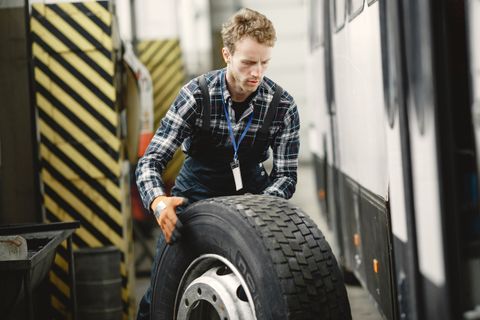
Mounting, dismounting, and balancing. Repairs where a repair is legitimate and honest replacement where it is not. Valve stems, extensions and hardware. Pressure checks and correction across all positions, including the inside duals nobody wants to reach. Wheel and rim inspection, because a corroded or cracked rim is a failure that gets blamed on the tire. Torque to spec on every wheel we touch, and a re-torque recommendation you should actually follow.
We also do the part that most tire service skips: telling you why the tire wore the way it did. A tire is a record of everything happening at that corner of the truck. Reading it is free and it is where the money is.
We supply the tires as well as install them, so you are not sourcing rubber on one call and service on another. If you already buy your own, that is fine too and we will fit what you have.
Casing management and retread programs are not usually something we run. If that is central to how your fleet buys tires, say so early and we will tell you honestly where we fit around it.
Even wear across a tire means everything at that wheel end is doing its job. Anything else is the truck telling you something specific.
Wear on both shoulders is chronic underinflation. Wear down the center is overinflation. Wear on one shoulder only is usually alignment or a bent component. Cupping and scalloping point at the suspension, shocks, or a wheel end problem rather than at the tire. Feathering across the tread points at toe. Fast wear on one drive tire and not its partner usually means mismatched duals, where two tires of different diameter are sharing a load unequally and one of them is losing.
Steer tires tell you the most, which is why they are worth looking at every time somebody is under the truck. What they usually tell you is that the problem is somewhere in suspension and steering rather than in the rubber. Replacing a worn steer without fixing what wore it just resets the clock on the same bill.
A tire ten percent under pressure is not a tire with a small problem. It runs hotter, wears its shoulders, burns measurably more fuel, and is far more likely to fail catastrophically rather than gracefully.
The trouble is that underinflation is invisible. A tire can be twenty PSI down and look completely normal from the ground, which is why the "kick the tires" version of a pre-trip finds almost nothing. It takes a gauge, and it takes somebody reaching the inside duals, which is the exact step that gets skipped when a driver is in a hurry.
Pressure checks on all positions are on the checklist for every scheduled service we do, and for fleets running on-yard maintenance it happens on every pass without anyone having to remember. That single habit does more for tire cost per mile than any purchasing decision a fleet of this size will make.
Tire work is some of the most useful mobile service there is, because a truck with a tire problem is usually already parked somewhere.
On your yard we handle mounting, dismounting, pressure correction, valve work, and replacement as part of scheduled service or on call. It fits naturally alongside everything else described on our mobile repair page, and it means a unit does not make a separate trip for tires.
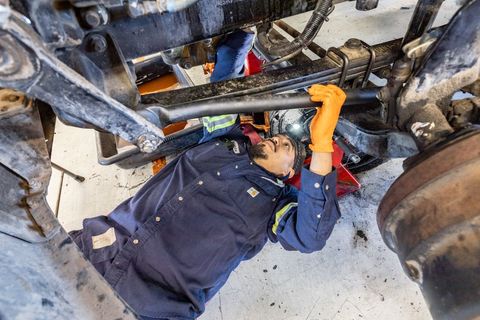
On the road, a tire failure is a roadside call and one of the more common ones we get. In the shop, tire work usually happens because the unit is in anyway, or because what looked like a tire problem turned out to be a wheel end, an alignment issue, or a suspension component that needs the truck up and apart to sort out properly.
Age matters as much as tread on the positions that sit. A trailer that spends months parked between runs can time out its tires long before it wears them, and sidewall cracking on a tire with plenty of tread left is a failure waiting for the first hot afternoon on I-85. Tread depth is the easy number to check, which is exactly why it is the only one most fleets look at.
The tire is the smallest line on that invoice.
A casing letting go at speed does not leave quietly. It takes fenders, mudflaps, air lines, wiring, and sometimes the fuel tank strap with it, and the debris damage is frequently worth more than the tire several times over. Then there is the driver on a shoulder, the load running late, and a roadside service call at a time and place you did not pick.
There is also the part fleets forget: a tire that fails from underinflation or age was almost always visible before it failed. Shoulder wear, sidewall cracking, a slow leak somebody kept airing up, a casing nobody looked at closely because it still had tread. Those are all things a technician sees on a routine pass, and they are also the things that get missed when tires are only ever addressed once they have already become an emergency. Tires are the clearest example of the whole argument for scheduled maintenance, which is that the truck tells you first, if somebody is looking.
We diagnose it.
You hear what we found.
You approve it.
We do the work.
Pricing on request, and references from fleets your size. What you will not get is a number you did not approve.
The work that usually rides along with this one.
“Turbo blew on 85. They took care of getting me towed to their shop. The next day, they jumped on my 379 pete and swapped my turbo and air to air. Charged my ac and was on my way.”Benjamin Deason · Google review, Greer
“Did a great job, felt like I knew the shop guys all my life. Bunch of good guys who seemed very knowledgeable.”
“Was on the road and ran into an issue. Looked this place up and they were right down the road. Got in and out quick and back on the road.”
“Called ACME for my driver who was on the side of I-85 in Greer. The line was busy, so I moved on and called another company. The gentleman with ACME not only called me back.”
Yes, and for a fleet it is usually the sensible way to handle it. Mounting, dismounting, pressure correction, and valve work all happen on site, either as part of scheduled service or on call. It also means tires get handled without a unit making a separate trip somewhere for them.
Wear on one shoulder is usually alignment or a bent or worn component at that corner rather than a tire problem. Both shoulders wearing means underinflation. Cupping points at suspension or shocks. Whatever the pattern, replacing the tire without correcting the cause resets the clock on the same expense, so it is worth having somebody look at the wheel end.
Federal minimums are 4/32 of an inch on steer tires and 2/32 on all other positions, measured in a major tread groove. Those are the legal floor, not a target. A tire replaced at the minimum is a tire that spent its last months as your least safe component, and running to the line is how fleets end up with roadside violations.
Both. We supply tires and install them, so one call covers it. If you already have a buying relationship you want to keep, we will fit tires you supply without making it awkward. What we do not usually run is casing management or a retread program, so if that is central to how you buy, tell us early.
In the shop or in your yard. Same straight answers either way.
Mon to Fri, 8am to 5pm. After hours by arrangement.
Mobile trucks and roadside cover the Upstate. Dedicated on-yard technicians work anywhere in the Southeast.
Call the shop or send the request. You'll get the diagnosis straight and a number before we start.