Benjamin DeasonOwner-operator
★★★★★
“Did a great job, felt like I knew the shop guys all my life. Bunch of good guys who seemed very knowledgeable.”
2024
Exhaust and Turbo
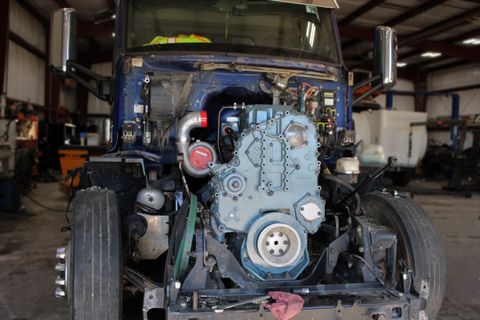
Engine work is the repair fleets dread, and usually for the wrong reason. The fear is the number. The real problem is that by the time an engine job is obviously an engine job, the decision has already been made for you. Every one of these starts small: a little coolant loss, oil consumption that crept up, a truck that is down on power in a way the driver stopped mentioning. The expensive version of this repair is almost always the one that got noticed late.
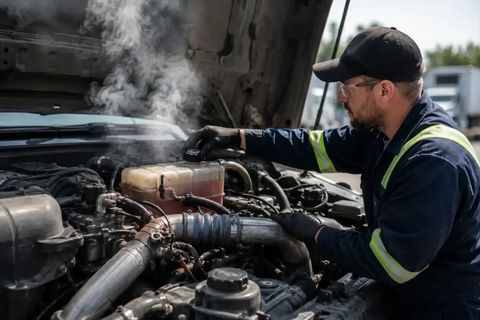
Diagnosis first, then the range of work that follows from it. Injectors and injector cups. Fuel system components and delivery problems. EGR valves, coolers and the plumbing around them. Head gaskets and heads. Oil leaks traced to their actual source rather than to wherever the oil ended up. Turbo and charge air problems, which live on the exhaust and turbo page but are frequently the reason an engine is being looked at. Cooling system failures that have started doing engine-level damage.
The work goes all the way up. We do in-frame overhauls and complete engine replacements, which means an engine job does not have to leave for a dealer to get finished, and it does not have to be broken into pieces across two shops.
A note on what usually turns out to be the problem. Injector and injector cup failures, EGR cooler leaks, and head gasket issues account for a large share of what fleets arrive calling an engine failure, and all three are meaningfully smaller jobs than the words suggest, provided they are found before they have done secondary damage. That gap, between what a repair costs when it is caught and what the same repair costs six months later, is most of the reason this page exists.
An engine failure is an outcome. Something caused it, and if that something is still there when the repair is finished, you have bought a very expensive delay.
Coolant loss is the clearest example. A truck losing coolant with no puddle under it is losing it somewhere it should not be, and the honest work is finding where before anyone quotes a repair. Oil consumption that climbed is telling you about rings, valve guides, a turbo seal, or crankcase pressure, and those are four different jobs. Low power is fuel delivery, air delivery, restriction, or a sensor lying about one of them.
So we diagnose properly, we tell you what we found in plain language, and we tell you what we are not certain about. On an engine job, the difference between a good guess and an actual answer is the whole invoice.
Most catastrophic engine failures were preventable, and they were preventable cheaply.
Coolant that drifts out of additive spec quietly attacks liners and the water pump, and it does not warn you first. That is why coolant gets tested rather than eyeballed on every service we do, and it is covered on the cooling systems page. Oil and filters run past interval do measurable damage that never announces itself. An air filter nobody checked for restriction starves the engine and works the turbo harder than it was built for. A charge air leak makes the engine work harder for less, and the driver just reports that the truck feels tired.
None of that is dramatic. All of it is on a maintenance checklist, and all of it is cheaper than the alternative by a wide margin.
On an older truck, the right answer is sometimes not to fix it, and you deserve to hear that from the shop holding the wrench.
The questions that matter are what else on the unit is close behind, what the truck is worth once it is running, and what your operation needs from that seat. A tractor with a good frame, decent tires, sound brakes and 700,000 miles is a different conversation than one where the engine is simply the first thing to break out of five. We will give you what we know about the truck's condition, including the parts that are not our repair, and let you make the call.
What we will not do is quote the biggest job on the list because it is the biggest job on the list.
One more thing worth putting plainly. A fleet that hears the same recommendation from every shop it visits is not necessarily hearing the truth. It may be hearing the job that is easiest to quote. We would rather tell you a truck needs an injector than sell you an overhaul, and we would rather tell you it needs an overhaul than take a smaller job we know will not hold.
Engine work takes the truck out of service, and anyone who tells you otherwise is selling.
What we can control is that you know the scope before it starts, that you approve it, and that changes come back to you as they happen rather than at the end. Parts availability drives most of the timeline on this kind of work and it varies by make and by component, so we will tell you what we are waiting on rather than giving you a date we invented. If the unit is going to be down anyway, it is usually worth pulling forward whatever else the truck is due for while it sits, because you are already paying the expensive part of this bill, which is the empty seat.
We diagnose it.
You hear what we found.
You approve it.
We do the work.
Pricing on request, and references from fleets your size. What you will not get is a number you did not approve.
Symptoms often start one system over. If the diagnosis points there, these are the usual suspects.
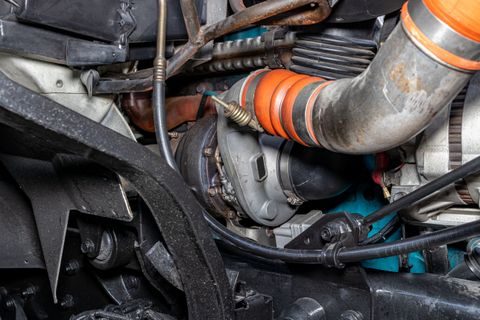
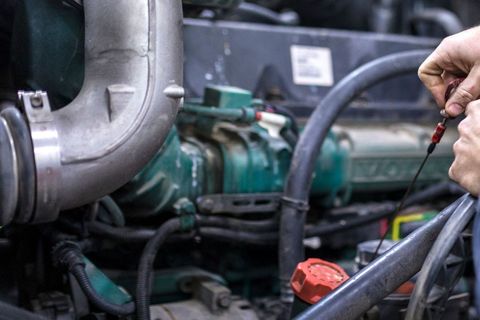
“Turbo blew on 85. They took care of getting me towed to their shop. The next day, they jumped on my 379 pete and swapped my turbo and air to air. Charged my ac and was on my way.”Benjamin Deason · Google review, Greer
“Did a great job, felt like I knew the shop guys all my life. Bunch of good guys who seemed very knowledgeable.”
“Was on the road and ran into an issue. Looked this place up and they were right down the road. Got in and out quick and back on the road.”
“Called ACME for my driver who was on the side of I-85 in Greer. The line was busy, so I moved on and called another company. The gentleman with ACME not only called me back.”
It means the coolant is going somewhere it should not be, which is worth taking seriously right away. The usual candidates are into the oil, into the exhaust, or out as vapor from a pressurized leak that closes up when cold. Each one is a different repair with a very different cost, and each one gets worse quickly. Do not top it off and keep running.
The number that matters is the change, not the amount. A truck that has always used a quart on a given run is telling you less than a truck that suddenly needs two when it used to need one. Track it per unit and treat the trend as the signal. Rising consumption with no external leak is a conversation to have before it becomes an engine job.
Sometimes, and it depends on the rest of the unit more than on the engine. We will tell you what condition the truck is in overall, including the things that are not our repair, so you can weigh the job against what the unit is worth running. Fixing an engine in a truck that needs four other things is rarely the good decision.
No, and we would rather say that clearly. Internal engine work needs a lift, a clean space, and controlled conditions. Diagnosis travels perfectly well and we do that on customer yards regularly, which often means you know what you are dealing with before the truck ever moves. The repair itself belongs in Greer.
In the shop or in your yard. Same straight answers either way.
Mon to Fri, 8am to 5pm. After hours by arrangement.
Mobile trucks and roadside cover the Upstate. Dedicated on-yard technicians work anywhere in the Southeast.
Call the shop or send the request. You'll get the diagnosis straight and a number before we start.