Benjamin DeasonOwner-operator
★★★★★
“Did a great job, felt like I knew the shop guys all my life. Bunch of good guys who seemed very knowledgeable.”
2024
Exhaust and Turbo

A liftgate is the only component on a truck that can be completely dead while the truck itself is perfect. The engine runs, the brakes are good, the unit is legal, and it still cannot do the job it was bought for, because the freight cannot get off it. For anyone running final mile, retail delivery, or anything where the receiver has no dock, the gate is not an accessory. It is the reason the truck exists, and it fails more often than anything else on the vehicle.
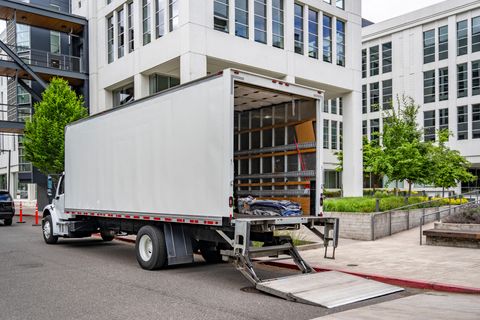
Liftgates are three systems in a hostile environment, and each one fails in its own way.
The electrical side is the most common by a wide margin. Batteries that are undersized, aging, or never fully recharging. Cables and terminals that corrode where they run under the truck. Solenoids, switches, and controls that fill with water. Grounds that look fine and are not.
The hydraulic side is next: pump motors, cylinders, seals, hoses and fittings, and fluid that is low, contaminated, or the wrong viscosity for the season. A gate that lifts slowly, or lifts empty and struggles loaded, is usually telling you about hydraulics or about the electrical supply feeding the pump.
Then the mechanical side, which is wear rather than failure: pins, bushings, hinges, the platform itself, latches, and the ramp or flip plate that takes physical abuse every single stop.
We work on the common configurations: rail gates, tuck-under gates, cantilever gates and railgates. And we do both sides of it, repair and service on what you have, plus installation when a gate is far enough gone that repairing it is no longer the honest recommendation. That second part matters more than it sounds like it should, because the shop telling you a gate is finished should be willing to say so knowing it costs them the repair.
If your gates are failing and nobody has looked at the charging path, that is where to start.
A liftgate draws heavily and recharges slowly, and on routes with many stops and short drives between them, the batteries never come back to full. Over months that undercharge kills the batteries, and the fleet replaces them, and the cycle repeats because nothing about the charging path changed. A gate that is slow at the end of the day and fine in the morning is describing exactly this.
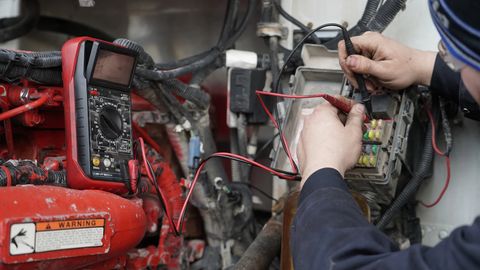
That is why gate problems get diagnosed the same way any other chronic electrical fault does, by testing the charging path, the cables, the grounds and the actual draw rather than by replacing the batteries again. It is the same method described on our electrical diagnostics page, applied to the part of the truck that determines whether the delivery happens.
Weather makes all of this worse on a schedule you can predict. Cold thickens hydraulic fluid, which makes the pump work harder against a battery that is already delivering less in the cold, which is why gate failures cluster in the first genuinely cold week of the year. A gate that was marginal in October is a gate that does not lift in January, and every fleet running delivery work sees the same pattern annually. That predictability is an opportunity: the gates that will fail this winter can be found in the fall.
Liftgates are the most-cycled component on a delivery truck and the least-maintained. Every stop is a cycle. A route truck can put more wear on its gate in a year than the chassis sees in three.
What a scheduled gate service actually covers is unglamorous and effective: hydraulic fluid level and condition, hose and fitting inspection, cylinder and seal condition, pin and bushing wear, structural and weld inspection at the mounting points, battery condition and charging performance under load, cable and terminal condition, and full function testing through the whole cycle, loaded if possible.
Doing that on the same visit as the rest of the truck's preventive maintenance costs almost nothing extra and prevents the failure mode that hurts most, which is the gate quitting mid-route with freight on it.
One habit worth building into a delivery operation: have drivers report a gate that is getting slower, not just a gate that has stopped. Slower is the only warning these units give, and it is a warning that arrives weeks ahead of the failure. Most fleets never capture it because there is no obvious place to report something that still technically works.
Most gate work is on-site work and should be. The trucks are usually back in the yard at a predictable time, the gate is accessible without a lift, and the electrical and hydraulic service that prevents most failures needs nothing a service truck does not carry.
The shop handles structural repair, mounting and frame issues, and anything requiring the gate substantially disassembled or the truck elevated. If a gate has been limping for weeks, bringing it in once is cheaper than three roadside visits that each get it working until the end of the day.
It is worse than a truck being down, and fleets consistently underrate it.
A truck with a mechanical problem is out of service and everybody knows it. A truck with a dead gate goes out, arrives, and cannot complete the delivery, which means the freight comes back, the customer is told after the fact, and somebody has to run it again tomorrow. You paid for the driver, the fuel, and the miles, and you got nothing, and you still owe the delivery.
Then it happens twice more before anybody escalates it, because a gate that is intermittent gets reported as bad luck rather than as a defect. And drivers, who are the ones physically fighting a failing gate at every stop, quietly stop wanting that truck.
We diagnose it.
You hear what we found.
You approve it.
We do the work.
Pricing on request, and references from fleets your size. What you will not get is a number you did not approve.
The work that usually rides along with this one.
“Turbo blew on 85. They took care of getting me towed to their shop. The next day, they jumped on my 379 pete and swapped my turbo and air to air. Charged my ac and was on my way.”Benjamin Deason · Google review, Greer
“Did a great job, felt like I knew the shop guys all my life. Bunch of good guys who seemed very knowledgeable.”
“Was on the road and ran into an issue. Looked this place up and they were right down the road. Got in and out quick and back on the road.”
“Called ACME for my driver who was on the side of I-85 in Greer. The line was busy, so I moved on and called another company. The gentleman with ACME not only called me back.”
Usually not. Gates draw heavily and recharge slowly, and on multi-stop routes with short drives the batteries never return to full, which kills them regardless of size. The fix is testing the charging path, the cables and the grounds and finding why they are not recharging. Replacing batteries again without that is buying the same repair on a schedule.
That pattern almost always points at electrical supply rather than hydraulics. The batteries are starting the day charged and being drained faster than the truck can replace the charge. It can also be a hydraulic issue that gets worse as fluid heats, so it is worth testing both, but the charging path is where we would start.
Yes, and that is where most of this belongs. Fluid, hoses, cylinders, pins and bushings, battery and charging testing and full function checks all happen on site. Structural and mounting repair, or anything needing the truck up, comes to Greer.
More often than the chassis, because every stop is a cycle and a route truck cycles its gate constantly. The practical answer is to fold gate service into the same schedule as the truck's regular maintenance so it happens automatically. Gates almost never give warning before they quit, so the inspection is the only warning you get.
In the shop or in your yard. Same straight answers either way.
Mon to Fri, 8am to 5pm. After hours by arrangement.
Mobile trucks and roadside cover the Upstate. Dedicated on-yard technicians work anywhere in the Southeast.
Call the shop or send the request. You'll get the diagnosis straight and a number before we start.