Benjamin DeasonOwner-operator
★★★★★
“Did a great job, felt like I knew the shop guys all my life. Bunch of good guys who seemed very knowledgeable.”
2024
Exhaust and Turbo
A driver tells you the truck took a while to build this morning. Nobody writes it up, because it built eventually and the load had to go. Two weeks later the same truck will not release its brakes in a customer yard at six in the morning, and now it is a tow and a phone call. Air problems almost never announce themselves. They start as a small inconvenience that the truck works around, right up until the day the truck cannot.
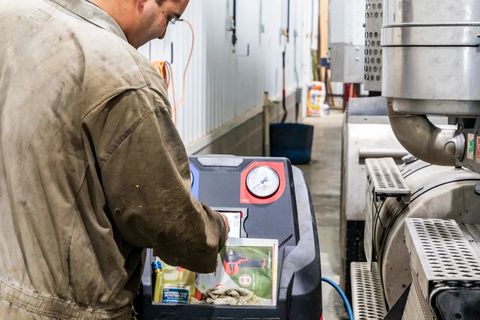
Air is not just brakes. On a modern tractor it holds up the suspension, shifts the transmission on some spec, runs the seat, works the cab controls, drives the fan clutch, and releases the parking brakes. The compressor is sized to keep up with normal demand and a certain amount of loss. Once total leakage passes what the compressor can replace, everything downstream starts behaving badly at once, and the symptom you notice first is rarely the system that is actually failing.
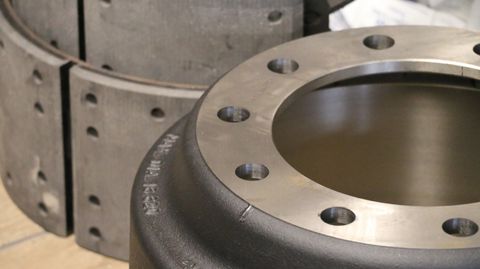
That is also why an air problem so often shows up as a brake complaint. A pedal that feels long, a truck that will not release cleanly, a trailer that seems to be doing all the work: those get diagnosed as brake problems and sometimes they are, but a system that leaks down overnight is a supply problem wearing a friction problem's clothes. We rule out the air before anybody sells you shoes.
The whole supply and control side: the compressor, governor, air dryer and its cartridge, wet and dry tanks, drain valves, check valves, pressure protection valves, relay and quick release valves, the treadle, the park control, spring brake chambers, gladhands and trailer supply lines, and the hundreds of feet of line and fittings tying all of it together.
Most of what we actually find is unglamorous. A chafed line where somebody routed it against a frame rail. A fitting that was never quite right. A dryer cartridge that has been in service years past its useful life and is passing moisture and oil straight into the system. The parts are small. Finding the right one is the job.
On the bigger hardware we replace rather than rebuild. Compressors, governors, and the larger valves come out and new ones go in. A rebuilt compressor is a truck you tend to see again, and doing that job twice costs more in downtime than the part saved the first time.
The hard leaks are the ones that are not there when you go looking.
A truck that holds pressure fine at operating temperature and dumps overnight is telling you something specific, usually about a seal that behaves differently cold, or about a leak small enough that the compressor masks it entirely while the engine is running. Guessing at that costs more than testing for it. We do the work properly: build the system to full pressure, shut it down, measure the actual leak-down rate against spec, isolate the sections, and find where it is going rather than replacing the parts that fail most often and hoping.
That takes time, and time is what most shops will not spend on an air complaint. It is also the difference between fixing it once and seeing the truck again in a month.
Half the air system failures we see in January were created the previous summer.
An air dryer that is past due stops removing moisture. That water collects in the tanks, and if nobody is draining them it moves through the system, into valves that were not designed to hold it. In warm weather it is corrosion and sticky valves. In cold weather it freezes, and a frozen valve is a truck that will not build, will not release, or does something worse at an inconvenient moment. Oil carryover from a tired compressor does its own version of the same damage, swelling seals and coating the inside of the dryer until it stops working entirely.
None of that is expensive to prevent. Draining tanks and changing a dryer cartridge on schedule is one of the highest-return items on a truck, and it is exactly the sort of thing that gets caught on a scheduled pass rather than by a driver. It is on the checklist for every PM we do, for this reason.
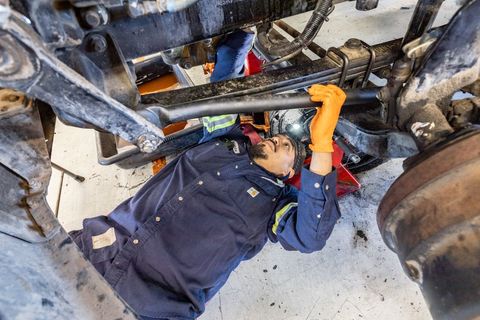
Air work splits cleanly. Leak testing, line and fitting repair, valve replacement, dryer cartridge service, and gladhand and trailer line work are all things our technicians handle on your yard or on the shoulder. A truck that will not release its parking brakes in a customer lot is a roadside call, and it is often a short one once somebody who knows what they are looking at is standing next to it. On call means a real technician answers, not a dispatch queue.
Compressor work, anything requiring the truck up on a lift for an extended chase, and any air problem that has already damaged something else belongs in Greer. If a unit has been fighting air for a while, the shop is usually the cheaper answer, because the real cost is the third visit, not the first.
Every fleet has a truck that everybody knows takes a minute to build. That knowledge is expensive.
A slow leak is a compressor running far more than it should, wearing out early and pushing oil downstream while it does. It is moisture accumulating in a system that was designed to stay dry. It is a driver who has learned to start the truck ten minutes early, which works fine until the morning it does not. And it is an out-of-service violation waiting for a roadside inspection, because leak-down rate is measured and it is a written standard, not a judgment call.
The repair is almost always small. The event it prevents is not.
We diagnose it.
You hear what we found.
You approve it.
We do the work.
Pricing on request, and references from fleets your size. What you will not get is a number you did not approve.
Symptoms often start one system over. If the diagnosis points there, these are the usual suspects.
“Turbo blew on 85. They took care of getting me towed to their shop. The next day, they jumped on my 379 pete and swapped my turbo and air to air. Charged my ac and was on my way.”Benjamin Deason · Google review, Greer
“Did a great job, felt like I knew the shop guys all my life. Bunch of good guys who seemed very knowledgeable.”
“Was on the road and ran into an issue. Looked this place up and they were right down the road. Got in and out quick and back on the road.”
“Called ACME for my driver who was on the side of I-85 in Greer. The line was busy, so I moved on and called another company. The gentleman with ACME not only called me back.”
Bad enough to test properly. Overnight loss means there is a leak the compressor hides while the engine is running, and it will get worse rather than better. The immediate risk is a truck that will not release in the morning or will not build enough to move. The longer risk is a compressor working overtime and putting heat, oil, and moisture into a system that cannot handle it.
On an interval, not on a symptom. By the time a dryer is obviously failing, water has already been through the system and the damage is downstream. Interval depends on how the truck runs, how humid your operating area is, and how hard the compressor is working, which in the Upstate is a real factor. We set it as part of a maintenance schedule rather than waiting for a complaint.
A small amount is normal and is exactly why the tanks have drains. A lot of water means the air dryer is no longer doing its job. Oil in with the water usually means the compressor is passing it, which is a separate and larger conversation. Either way, tanks should be drained on a schedule and what comes out is worth looking at.
Most of the time we can find and fix it on the yard. Leak testing, line repair, fittings, and most valve work are all on-site jobs. If the leak turns out to be the compressor, or if the chase needs the truck on a lift for a while, bringing it to Greer is faster than doing it twice.
In the shop or in your yard. Same straight answers either way.
Mon to Fri, 8am to 5pm. After hours by arrangement.
Mobile trucks and roadside cover the Upstate. Dedicated on-yard technicians work anywhere in the Southeast.
Call the shop or send the request. You'll get the diagnosis straight and a number before we start.