Benjamin DeasonOwner-operator
★★★★★
“Did a great job, felt like I knew the shop guys all my life. Bunch of good guys who seemed very knowledgeable.”
2024
Exhaust and Turbo
Almost nobody loses an engine to a dramatic overheat. They lose it to a cooling system that was slightly wrong for a long time. The gauge never pegged. The truck never shut down. It just ran a little warmer than it should have on grades, and the coolant had quietly stopped being coolant somewhere around eighteen months ago. Cooling is the least visible system on a truck and the one with the shortest distance between neglected and catastrophic.
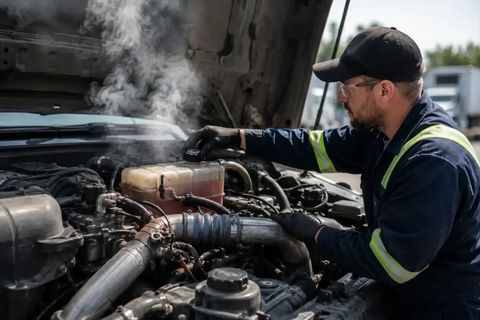
Radiators, from corrosion, road debris, and vibration at the mounts. Water pumps, which announce themselves with weep, noise, or play at the shaft if anyone is looking. Thermostats, which fail closed and cook a truck or fail open and cost you fuel and heat all winter without anybody noticing anything is wrong.
Then the parts fleets forget. Hoses and clamps, which have a service life whether or not they are leaking today. Fan clutches and the electrical or air control that drives them, where a fan that stopped engaging turns into an overheat on the first hot grade. Charge air coolers and their piping, which sit right there in the same airflow and cause problems that look like cooling problems. EGR coolers, whose failures put combustion gases into the coolant and are one of the ways a truck loses coolant with nothing at all on the ground. Radiator caps and surge tanks, which are the cheapest part on the truck and are genuinely capable of causing an overheat.
A truck losing coolant that leaves no trace under it is the one to take seriously immediately.
The coolant is going somewhere, and the candidates are all expensive: into the oil, into a cylinder through a head gasket or a liner seal, into the exhaust where it leaves as vapor, or through an EGR cooler. Every one of those does progressive damage while you top it off and keep running, and the truck usually gives you weeks of warning before it gives you a failure. Pressure testing the system tells you a great deal in very little time, and it is worth doing at the first unexplained top-off rather than the fourth. This is exactly where cooling work becomes engine work, and the gap between catching it here and catching it there is enormous.
This is the part fleets get wrong most consistently, and it costs the most.
Coolant is a chemical system with a service life. The additive package that protects your liners, water pump seals and radiator depletes over time, and once it is gone the coolant looks completely normal while cavitation quietly eats pitting into the cylinder liners. Nothing warns you. There is no light, no gauge, no noise. The first symptom is an engine failure that arrives years later and gets blamed on mileage.
That is why coolant gets tested rather than looked at on every service we run, for freeze point and for additive level both, and it is on the checklist for every PM pass. Mixing coolant types, or topping off with whatever is on the shelf, undoes the chemistry as effectively as never servicing it. If your trucks have been topped off by several different people over several years, testing the coolant is one of the highest-value hours you can spend on a fleet.
One more thing worth knowing about coolant: it is the fluid most likely to be wrong on a truck you just bought. Used units arrive having been topped off by whoever owned them, with whatever was on that shelf, for however long. Testing coolant on an incoming unit is a fifteen minute job that occasionally tells you something important about what you have actually purchased.
A lot of this travels. Hoses, clamps, thermostats, coolant service and testing, fan clutch replacement, pressure testing and leak diagnosis are all things our technicians do on customer yards, and pressure testing on site is the single most useful thing we can do for a truck that keeps needing coolant.
Radiator and charge air cooler replacement, EGR cooler work, and anything that turns into internal engine investigation belongs in Greer. If a truck is overheating badly enough that it is derating or shutting down, do not run it in to save a tow. An engine damaged on the way to the shop is the most avoidable repair there is.
The gauge is a poor instrument for this. By the time it moves, the situation is already advanced.
A truck running consistently warmer than it should is losing power, using more fuel, working the aftertreatment harder, and shortening the life of everything under the hood, all without ever setting off an alarm. Meanwhile the actual failures wait for the worst possible conditions, because cooling systems fail on hot days, on grades, loaded, which is precisely when a truck is furthest from help and most expensive to recover.
And the endgame is not a repair, it is an engine. Liner pitting, a warped head, a scored cylinder: those are the outcomes of a cooling system nobody serviced, and they arrive as a five-figure decision on a truck you had other plans for. The prevention is a coolant test and a set of hoses.
We diagnose it.
You hear what we found.
You approve it.
We do the work.
Pricing on request, and references from fleets your size. What you will not get is a number you did not approve.
Symptoms often start one system over. If the diagnosis points there, these are the usual suspects.
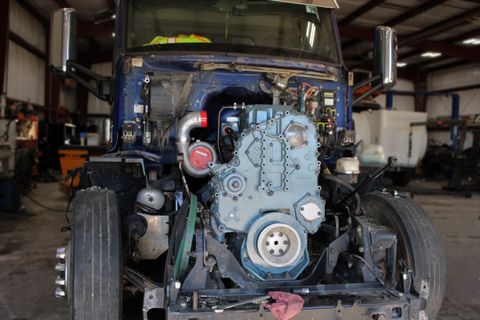
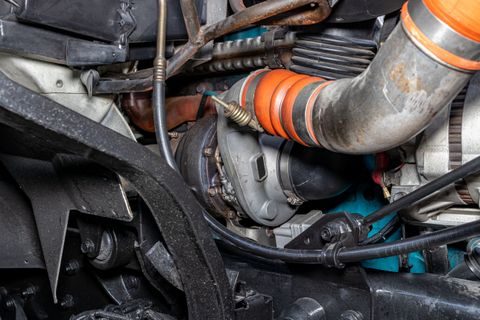
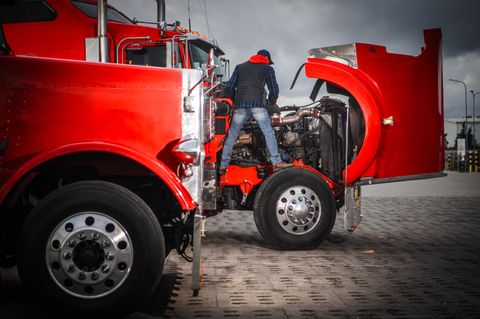
“Turbo blew on 85. They took care of getting me towed to their shop. The next day, they jumped on my 379 pete and swapped my turbo and air to air. Charged my ac and was on my way.”Benjamin Deason · Google review, Greer
“Did a great job, felt like I knew the shop guys all my life. Bunch of good guys who seemed very knowledgeable.”
“Was on the road and ran into an issue. Looked this place up and they were right down the road. Got in and out quick and back on the road.”
“Called ACME for my driver who was on the side of I-85 in Greer. The line was busy, so I moved on and called another company. The gentleman with ACME not only called me back.”
Somewhere expensive, and it is worth finding now. Coolant with no external leak is usually going into the oil, into a cylinder, out through the exhaust as vapor, or through an EGR cooler. All four do progressive damage while you keep topping it off. A pressure test takes very little time and narrows it quickly, so make that the response to the first unexplained top-off rather than the fifth.
More often than most fleets assume, and the interval depends on the coolant type and how the truck runs. What matters more than the interval is testing it. The additive package that protects your liners and water pump depletes long before the coolant looks bad, so a visual check tells you almost nothing. We test freeze point and additive level on every service pass.
Try not to. Mixing coolant types dilutes or defeats the additive chemistry, and a truck that has been topped off from several different jugs over several years often has coolant that is protecting nothing. Keep one coolant standard across the fleet and label it where drivers can see it. If you are not sure what is in a unit, test it.
It can be. A thermostat stuck open, a fan clutch not engaging when it should, or a partially blocked radiator or charge air cooler will all affect how the truck performs before they affect what the gauge shows. Charge air problems in particular feel exactly like a power complaint. It is worth checking the cooling side before assuming the engine is tired.
In the shop or in your yard. Same straight answers either way.
Mon to Fri, 8am to 5pm. After hours by arrangement.
Mobile trucks and roadside cover the Upstate. Dedicated on-yard technicians work anywhere in the Southeast.
Call the shop or send the request. You'll get the diagnosis straight and a number before we start.