Benjamin DeasonOwner-operator
★★★★★
“Did a great job, felt like I knew the shop guys all my life. Bunch of good guys who seemed very knowledgeable.”
2024
Exhaust and Turbo
You have almost certainly paid for this truck twice. A code came up, a part got replaced, the light went out for a while, and then it came back. Now you are being told it is a different part. Somewhere in there you stopped buying repairs and started buying guesses, and the frustrating thing is that from the outside the two look identical on an invoice. Diagnosis is the part of this trade where the difference between a good shop and a cheap one is most expensive.

A fault code tells you which circuit or system reported something outside of expected range. It does not tell you why, and on a modern truck the difference matters enormously.
A code naming a sensor is frequently not a bad sensor. It is a connector full of corrosion, a wire chafed against a frame rail, a ground that has gone high resistance, or a genuine condition the sensor is correctly reporting and nobody believed. Replace the named part and one of three things happens: the light goes out and stays out, which means you got lucky; the light goes out and comes back, which means you paid for a part and learned nothing; or the light never goes out and you get told it must be something else.
This is why our diagnostics do not begin with a parts list. They begin with the truck.
First, confirm the complaint. What the driver reported and what the code says do not always describe the same event, and a fault that only happens loaded, or wet, or at temperature, is information rather than an inconvenience.
Then, look at what the truck is doing live rather than at what it recorded. Freeze frame data, live values across related sensors, and whether the numbers agree with each other and with physical reality. A sensor reporting a temperature the engine could not possibly be at is a different problem than one reporting something plausible but wrong.
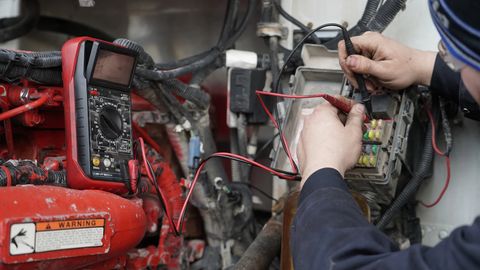
Then, test the circuit rather than the part. Power, ground, continuity, resistance, and voltage drop under load, which is where the intermittent faults live and where most diagnoses stop too early. A great deal of what gets called an engine problem lives in the harness and belongs with electrical diagnostics.
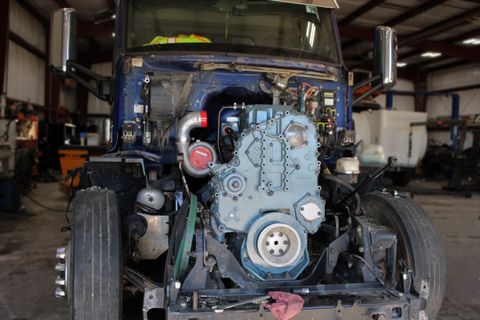
And then the mechanical side, because sensors report on conditions that are often real. Aftertreatment faults trace upstream to injectors, turbo, and EGR. Power complaints trace to fuel delivery, air delivery, or restriction. The code told you where the truck noticed. The job is finding where it started, which frequently ends up in engine territory.
We run the major manufacturer and standard diagnostic software the makes we service require, so a truck does not have to visit a dealer to be read properly. What matters more is what gets done with it. Software tells you what the truck recorded. It does not tell you why, and no shop has ever been saved by a laptop.
If a truck has been in twice for the same fault, that unit needs a different conversation, not a third part.
We would rather start those from the beginning than from where the last shop left off. What has already been replaced is useful information, mostly because it tells us what the problem is not. But inheriting somebody else's theory is how a truck gets a fourth repair. So we re-verify the complaint, re-check the basics that get skipped when everyone assumes they were already checked, and work forward from what the truck is doing today.
Sometimes the honest answer is that we do not know yet and it needs more time. You will hear that instead of a confident guess. A shop that is never uncertain is a shop that has stopped diagnosing.
Most diagnosis does not need a lift. It needs a technician with the truck in front of them and the time to do it properly, which travels perfectly well to your yard. Our mobile technicians diagnose on site regularly, and for a fleet that is often the difference between knowing what is wrong with a unit and continuing to run it while you wonder.
What we ask for either way is time. Diagnosis priced and scheduled like a quick look is diagnosis that stops at the first plausible answer, and the first plausible answer is what put the truck in this situation. Booking it honestly is part of doing it correctly.
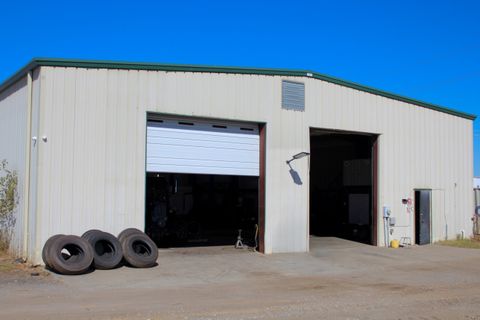
The shop in Greer is better when the fault requires the truck under load, when the chase needs the unit apart or elevated for a stretch, or when the diagnosis is likely to turn straight into the repair and moving the truck twice makes no sense.
The parts are the visible cost and usually the smaller one.
A misdiagnosed truck goes back into service still broken, which means a second failure at a time and place you do not control, often worse than the first. Meanwhile the actual cause has had a few more weeks to work on something else. An injector that plugged a filter does not stop at the filter. A charging fault that killed a battery will kill the next one too. A boost leak that was called a turbo will still be there when the new turbo arrives.
And there is a cost that never appears on an invoice at all: the driver who has stopped reporting problems because nothing gets fixed anyway. That silence is expensive, and it is difficult to undo. Diagnosing correctly the first time is not a premium service. It is the cheapest version of the repair.
We diagnose it.
You hear what we found.
You approve it.
We do the work.
Pricing on request, and references from fleets your size. What you will not get is a number you did not approve.
The work that usually rides along with this one.
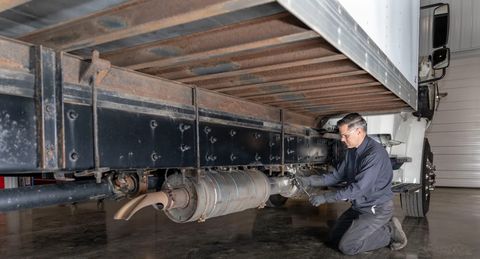
Forced regens, cleanings, and sensor faults, fixed at the cause.
View repair ›“Turbo blew on 85. They took care of getting me towed to their shop. The next day, they jumped on my 379 pete and swapped my turbo and air to air. Charged my ac and was on my way.”Benjamin Deason · Google review, Greer
“Did a great job, felt like I knew the shop guys all my life. Bunch of good guys who seemed very knowledgeable.”
“Was on the road and ran into an issue. Looked this place up and they were right down the road. Got in and out quick and back on the road.”
“Called ACME for my driver who was on the side of I-85 in Greer. The line was busy, so I moved on and called another company. The gentleman with ACME not only called me back.”
It depends on which fault and whether the truck is derating. A steady lamp with no performance change is a warning worth reading soon rather than tonight. Anything flashing, anything derating, and anything accompanied by a change in how the truck drives should stop being deferred. Call and tell us what the dash is doing and we will tell you which one you have.
Yes, and most of the time that is the right call. Diagnosis needs time and the truck present far more than it needs a lift. Our technicians do this on customer yards regularly. If the fault only appears under load, or the chase needs the unit elevated for a while, we will tell you it is better done in Greer.
Yes, and that is the point. What was already replaced tells us what the problem is not, which is useful. Inheriting the previous theory is what produces a third wrong part. We re-verify the complaint and work forward from what the truck is doing now rather than from where somebody else stopped.
Freightliner, International, Volvo, Mack, Kenworth, Peterbilt, Western Star and Hino make up most of what comes through. Diagnostic method does not change much between makes. If you run something unusual, ask before you send it, and we will give you a straight answer about whether we are the right shop for it.
In the shop or in your yard. Same straight answers either way.
Mon to Fri, 8am to 5pm. After hours by arrangement.
Mobile trucks and roadside cover the Upstate. Dedicated on-yard technicians work anywhere in the Southeast.
Call the shop or send the request. You'll get the diagnosis straight and a number before we start.