Benjamin DeasonOwner-operator
★★★★★
“Did a great job, felt like I knew the shop guys all my life. Bunch of good guys who seemed very knowledgeable.”
2024
Exhaust and Turbo

Driveline problems get tolerated longer than anything else on a truck, because they start as a feeling rather than a fault. A vibration at a certain speed. A clunk taking up load at a light. A noise that changes when you let off. Drivers adapt, dispatch never hears about it, and the complaint becomes a characteristic of that unit. Meanwhile the vibration is working on every component it touches, and driveline failures do not end quietly. A driveshaft that lets go at speed does real damage on its way out.
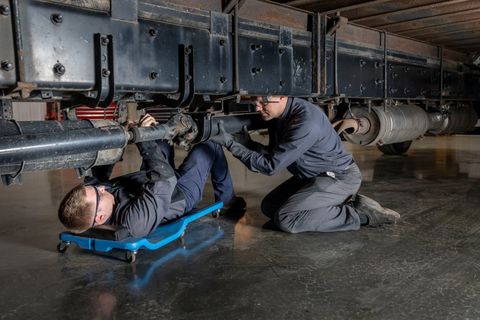
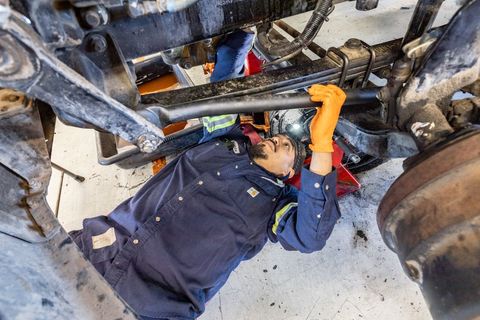
U-joints, slip yokes and center bearings. Driveshafts, including inspection for runout, balance and phasing. Differentials, including leaks, noise, and internal failures. Axle shafts and seals. Wheel ends, hubs and bearings. Power divider and inter-axle differential problems, which produce some of the most misread symptoms on a tandem. Yoke and pinion seals, which leak quietly and take out what they are supposed to protect.
Driveshaft balancing goes out to a shop that does nothing else, and comes back here to be installed. That is deliberate. Balancing is specialist work and the equipment to do it properly is not something a general repair shop should pretend to have.
On differentials we replace the carrier with a remanufactured unit rather than rebuilding internally and setting up ring and pinion here. That is a deliberate call. Gear setup is precision work with very little margin, and a differential that was set up slightly wrong is a rebuild you pay for twice, the second time with a truck down on a road you did not choose.
A vibration is not a comfort issue. It is energy going somewhere it was not designed to go, continuously, every mile the truck runs.
It fatigues the components producing it, so a worn u-joint gets worse faster the longer it runs worn. It works on everything nearby: transmission and differential bearings, mounts, the center bearing, seals that start weeping because they are being shaken. And it hides its own cause, because after a few weeks a vibration at road speed feels normal and nobody can tell you when it started.
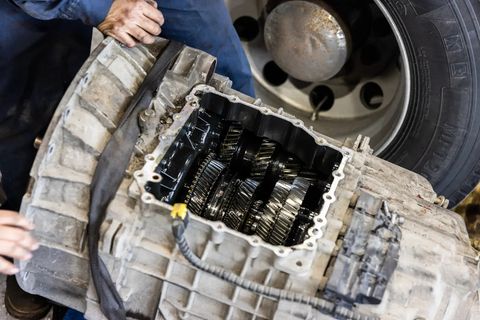
The other reason to chase it early is that vibrations are diagnostically honest. Whether the frequency tracks engine speed or road speed, whether it changes under load or coasting, and where in the truck it is felt all point at specific components. That information is most useful early, before enough parts are worn that everything is a suspect. Diagnosing it also means ruling in or out the transmission and clutch side, because a driveline complaint and a transmission complaint often sound identical from the seat.
Differentials and wheel ends fail from heat and from running on lubricant that is finished, and both of those are preventable at almost no cost.
Diff oil is not a lifetime fill. It shears down, it collects the metal that normal wear produces, and it stops carrying heat away. A differential run on old oil wears its gearset in a way that shows up as noise, then as a rebuild. Wheel end seals are the same story from the other direction: a seal that starts weeping is losing lubricant from a bearing and, if it is on a drive or trailer axle, is usually also contaminating a set of brake shoes on its way out.
None of that is a discovery, it is a checklist item. Lubricant levels and condition, seal condition, and u-joint play are all inspected on every PM pass, which is why fleets on a real maintenance schedule almost never have driveline surprises and fleets without one have them regularly.
Tandems deserve a specific mention, because they produce the most misread symptoms on a truck. A power divider or inter-axle differential problem can show up as a noise, a vibration, a driveability complaint, or as one axle doing more work than the other, and it gets diagnosed as almost anything before it gets diagnosed correctly. If a unit has been through several shops for a noise nobody could pin down, the power divider is worth ruling out before anything else gets replaced.
Inspection and a lot of the smaller work travels. U-joint play, driveshaft and center bearing inspection, lubricant checks, seal condition and leak diagnosis all happen fine on a customer yard, and a technician who can put hands on a driveshaft will tell you more in five minutes than a week of driver reports will.
Driveshaft removal, differential work, axle shaft and wheel end repair, and anything involving a vibration that needs the truck up and running under load belongs in Greer. If a driver reports a driveline noise that is getting rapidly worse, or any clunk severe enough to feel through the frame, treat it as a stop-driving situation rather than a schedule-it-next-week one. A driveshaft failure at speed is one of the few repairs on this site that can become a safety event rather than a bill.
Trailer axles are the ones that get forgotten, and they are also the ones most likely to be carrying a weeping seal nobody has looked at. A trailer gets dropped, sits, gets hooked by somebody who is not the person who last pulled it, and no single driver owns its condition. Running trailer wheel ends and seals through an inspection as a batch, on the yard, is one of the higher-return hours a fleet can spend.
A u-joint is inexpensive. A driveshaft dropping at highway speed is not, and it does not limit itself to the driveline.
It damages crossmembers, air lines, wiring, fuel and exhaust components, and occasionally the transmission it was attached to. It puts the truck on a shoulder rather than in a bay, which means recovery, a driver waiting, and a repair at whichever shop the tow operator chose. And unlike most failures on a truck, there is a real possibility of the failure taking something out on the road with it.
The version of this that costs almost nothing is a technician putting a hand on a driveshaft during a scheduled service and finding play. That is the entire difference.
We diagnose it.
You hear what we found.
You approve it.
We do the work.
Pricing on request, and references from fleets your size. What you will not get is a number you did not approve.
Symptoms often start one system over. If the diagnosis points there, these are the usual suspects.
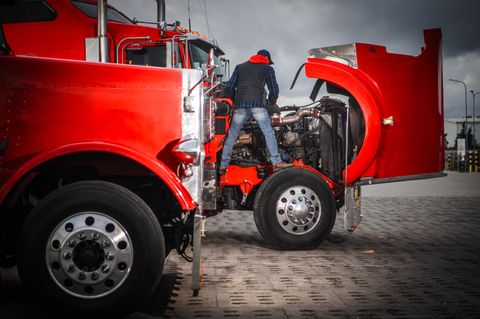
“Turbo blew on 85. They took care of getting me towed to their shop. The next day, they jumped on my 379 pete and swapped my turbo and air to air. Charged my ac and was on my way.”Benjamin Deason · Google review, Greer
“Did a great job, felt like I knew the shop guys all my life. Bunch of good guys who seemed very knowledgeable.”
“Was on the road and ran into an issue. Looked this place up and they were right down the road. Got in and out quick and back on the road.”
“Called ACME for my driver who was on the side of I-85 in Greer. The line was busy, so I moved on and called another company. The gentleman with ACME not only called me back.”
Both are common and they are distinguishable. A driveline vibration usually tracks with road speed in a narrow band and can change under load or coasting. A tire or wheel problem often appears at a specific speed and feels different in the steering versus the seat. Rather than guessing, have someone check u-joint play and driveshaft runout, and read the tires while they are there.
Usually driveline slack: worn u-joints, a worn slip yoke, or play in the differential. It can also be a mount or a suspension component. A clunk under load is worth looking at soon rather than living with, because whatever is producing the slack is wearing faster the longer it runs that way, and the components involved do not fail gracefully.
On an interval that matches how the trucks run, not when it looks bad, because it looks bad long after it stopped working. Diff oil shears down and collects wear metal, and a differential run on finished lubricant wears its gearset toward a rebuild. It is one of the cheapest items on a maintenance schedule and one of the most expensive to skip.
Yes, and it is a good use of an on-site visit. U-joint play, driveshaft and center bearing condition, seal weeping and lubricant levels can all be checked on your property across a group of units. It is fast, it needs no lift, and it finds the problems that would otherwise be reported months later as a noise somebody got used to.
In the shop or in your yard. Same straight answers either way.
Mon to Fri, 8am to 5pm. After hours by arrangement.
Mobile trucks and roadside cover the Upstate. Dedicated on-yard technicians work anywhere in the Southeast.
Call the shop or send the request. You'll get the diagnosis straight and a number before we start.