Benjamin DeasonOwner-operator
★★★★★
“Did a great job, felt like I knew the shop guys all my life. Bunch of good guys who seemed very knowledgeable.”
2024
Exhaust and Turbo
PM is the easiest thing on the list to push a week. Then the week becomes a quarter, and the unit that skipped its service is the one sitting on the shoulder. Most of what puts a truck out of service is something a technician would have found on a scheduled pass: a wet wheel seal, a chafed air line, a coolant level walking down, a slack adjuster past its stroke. Preventive maintenance is not a cost you carry. It is the one you trade for the tow.

A PM is not an oil change with a clipboard next to it. The oil and filters are the part everyone pictures, and they are maybe a fifth of the value.
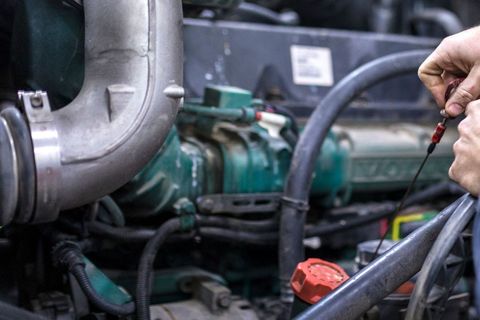
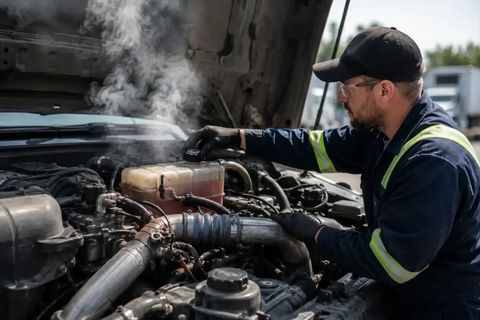
On a full service we pull engine oil and filters, fuel filters and the water separator, and we check the air filter for restriction rather than for age. Coolant gets tested, not eyeballed, for freeze point and additive level, because a coolant that has gone out of spec is quietly working on your liners and your water pump. Belts, hoses, charge air piping and clamps get inspected under load conditions where we can. The air dryer and tanks get drained and checked, which is the cheapest thing on this list and the one most often skipped.
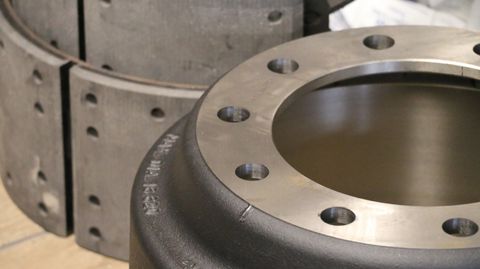
From there it is the chassis. Brake lining thickness, drum condition, and pushrod stroke measured at every wheel end. Tire depth and pressure on all positions, including the inside duals nobody wants to reach. Wheel ends and seals. Steering linkage, kingpins, and suspension components checked for play. Driveline and u-joints. Fifth wheel lube and plate wear. Lights, connectors, and the seven-way. DEF system and filter. A full chassis lube and a walk underneath looking for anything wet that should be dry.
Everything that comes back marginal gets called out with what it is, how urgent it is, and what happens if it waits. Fluids and filters have their own page if you want that level of detail.
The interval printed in the OEM manual is written for an average truck, and you do not run average trucks.
A regional tractor turning 10,000 miles a month in stop and go has a different wear curve than a straight truck doing short urban routes with heavy idle time, and both are different from a yard truck where hours mean more than miles. Idle hours, load weight, terrain, and how the trucks get driven all move the number. So does what you are trying to protect. A fleet trying to hit 800,000 miles on an engine services differently than a fleet trading units at four years.
We build the schedule to the fleet rather than dropping you into a preset tier. We would rather set the interval with you than hand you one. Tell us how the units run, what the duty cycle looks like, and what your history has been, and we will build a schedule around it and then adjust when the inspection findings tell us to. If you are running enough units for this to be a program rather than a series of appointments, that is what Fleet PM Programs is for.
Most fleets end up running both, and that is the right answer more often than picking one.
On-yard PM is what keeps trucks off our lot and on your schedule. A technician comes to where the units already sit, works through them in whatever order your dispatch can live with, and the truck never loses a day to travel. For fleets running a consistent volume, we place a dedicated technician on the yard, which is the model we run for national carriers across the Southeast. The same model works for a single yard.
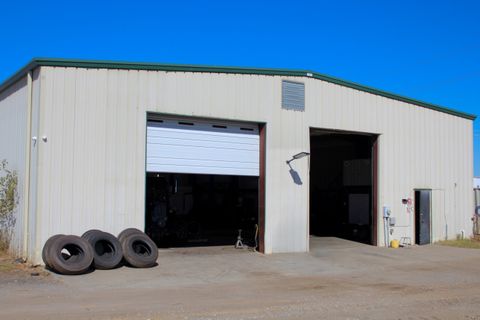
The shop in Greer is for what a yard cannot support: work that needs a lift, a clean floor, or a wheel end fully apart, and any deferred item from a PM that turns out to be bigger than a parking spot can handle. The useful thing about running both is that a finding on your yard on Tuesday does not have to become a separate diagnosis in a shop on Friday. It is the same technicians and the same notes.
A PM that only produces an invoice is not worth much to you. What you need is a record you can plan against.
Every service comes back with what was checked, what was measured, what was replaced, and a list of items that are not urgent today but will be. That deferred list is the part a fleet manager can actually use, because it turns next quarter's downtime into something you schedule instead of something that happens to you. Over a few cycles it also tells you which units are getting expensive, which is the conversation that decides what you keep and what you cycle out.
If you are running with us on a fleet program, we will share the history we hold on your units, so those trends are something you can look at on a schedule rather than something you have to keep in your head.
Nothing on a truck fails politely.
A coolant that drifted out of additive spec does not warn you. It eats liners and shows up as a rebuild. A wheel seal that was weeping at the last service soaks a set of brake shoes you paid for last quarter, and now you buy them twice, which is why we look at brakes on every pass. An air dryer nobody drained puts water through the system until a valve sticks in the winter. None of those are dramatic on the day they start. All of them are expensive on the day they finish.
Then there is the part that never shows on a repair order: the load that moved late, the driver who sat, the customer who noticed. A truck in a bay on a Tuesday you planned costs you a Tuesday. A truck on a shoulder on a Friday you did not costs considerably more than the repair.
We diagnose it.
You hear what we found.
You approve it.
We do the work.
Pricing on request, and references from fleets your size. What you will not get is a number you did not approve.
The work that usually rides along with this one.
“Turbo blew on 85. They took care of getting me towed to their shop. The next day, they jumped on my 379 pete and swapped my turbo and air to air. Charged my ac and was on my way.”Benjamin Deason · Google review, Greer
“Did a great job, felt like I knew the shop guys all my life. Bunch of good guys who seemed very knowledgeable.”
“Was on the road and ran into an issue. Looked this place up and they were right down the road. Got in and out quick and back on the road.”
“Called ACME for my driver who was on the side of I-85 in Greer. The line was busy, so I moved on and called another company. The gentleman with ACME not only called me back.”
It depends on duty cycle more than on mileage alone. Idle hours, load weight, terrain, and driver behavior all move the interval, and a truck doing short heavy runs with long idle time wears faster than the odometer suggests. Give us how the units actually run and what your failure history looks like, and we will set an interval with you rather than reading you one out of a manual.
Yes, and that is how most fleet PM should work. Our technicians come to the yard and work through units in whatever order your dispatch can live with, so a truck never loses a day to travel and a shop queue. On-yard work runs during business hours, so we build the rotation around which units you can spare. If your volume supports it, we can put a dedicated technician on the yard rather than sending someone out per visit.
They overlap but they answer different questions. A DOT annual inspection asks whether the truck meets a federal standard on that day and produces the required documentation. A PM asks what this specific unit needs next and catches things well before they become defects. Most fleets run both, and it is usually worth timing them together so a unit comes out of service once instead of twice.
We tell you. Anything beyond the agreed scope of the service comes back to you as a finding, with what we saw, how urgent it is, and what happens if it waits. You decide what gets done and when. The point of a PM is to give you the information early enough that the decision is still yours to make.
In the shop or in your yard. Same straight answers either way.
Mon to Fri, 8am to 5pm. After hours by arrangement.
Mobile trucks and roadside cover the Upstate. Dedicated on-yard technicians work anywhere in the Southeast.
Call the shop or send the request. You'll get the diagnosis straight and a number before we start.